
Anthropic IPO: We looked under the hood, here’s what the team found
By Dr David Allen, Portfolio Manager of the Plato Global Alpha Fund
The IPO date is now set down for 19 November. If successful it will be the largest IPO in history, surpassing Saudi Aramco.
On the surface, there’s plenty to like about Anthropic.
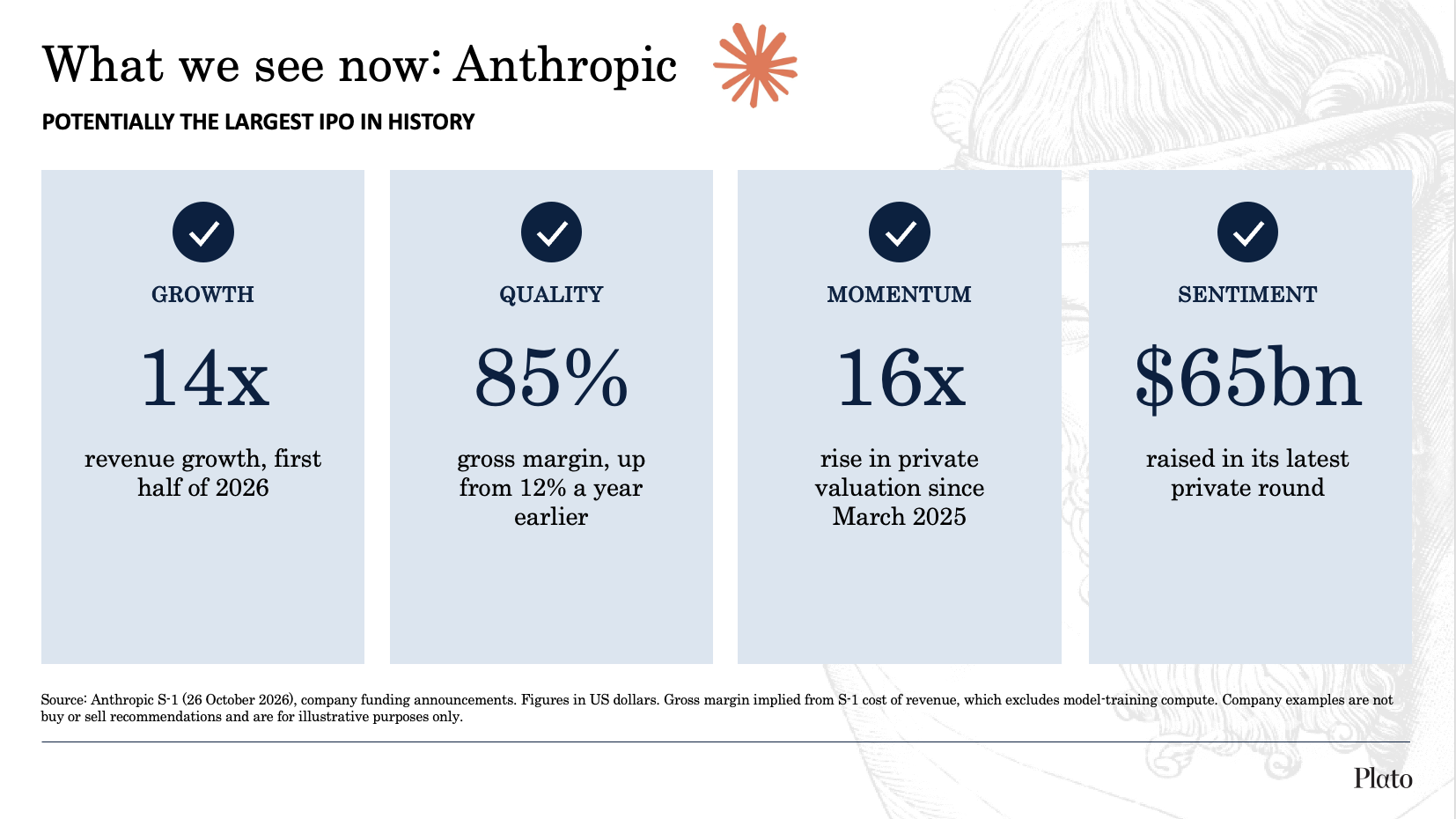
- First-half 2026 revenue growth of 14x.
- Gross margins of 85%, up from just 12% a year earlier.
- A private valuation that has risen 16x since March 2025, and $65 billion raised in its latest round.
- Not to mention Anthropic is at the forefront of what could be the most consequential technological revolution in human history.
So, it’s easy to see how this is set to potentially be the largest IPO in history. What a time to be alive.
But our investment team has spent a lot of time on the business in recent weeks looking under the hood, and this is where concerns start to quickly pile up.
Biggest Anthropic Red Flags
Before I go on, I should emphasise we’re style agnostic – we invest across value, growth and quality – so we don’t immediately ignore or screen out these big IPOs just because we’re anti-hype or because we are instinctively against anything popular.
But there are striking red flags that provide significant cause for concern. These are the ones that really stand out to me.
Locked-in costs
At the top of the pile is roughly $895 billion in committed future spending, overwhelmingly related to compute. That’s a remarkable long-term financial commitment against a revenue base where 79% is consumption-based, rather than traditional subscription revenue. While some customers have minimum spending commitments, future demand remains inherently uncertain.
Back to losses
The company swung from a $974 million operating profit in the second quarter to a $567 million loss in the third.
Potential junk rating
Blackstone now expects the debt to be rated BB – junk, not investment grade.
TAM hype
Anthropic’s prospectus points to more than $40 trillion in global economic activity associated with knowledge work. That’s larger than the entire US economy. But there’s a world of difference between the economic value of work AI could transform and the revenue AI companies can actually capture.
Porous moat
There are structural issues too. Stanford University’s 2026 AI Index Report found that the best open-weight model (often free to download and use), was only 3.3% behind the leading proprietary model.
Talent costs and leakage
Personnel costs have risen almost fivefold in a year. Why? Because AI researchers hold the precious intellectual property that makes AI possible in their grey matter. Matt Deitke, a 24-year-old researcher is reportedly earning US$250m over 4 years at Meta. Andrew Tulloch a former OpenAI researcher was reportedtly offered US$1.5b over 6+ years although Meta disputed that figure.
Founder control
Anthropic has established a special entity called Founder LLC, controlled collectively by its seven co-founders. Founder LLC holds a single Class F share carrying 50.1% of shareholder voting power. This means the founders can retain control even if they sell down much of their economic ownership.
No AI payoff, yet
As highlighted by Apollo there remains big question marks about measurable AI profitability gains across the S&P 493 (the S&P 500 minus the Magnificent 7).
Cost per Unit of Intelligence is Crashing
The cost of AI intelligence is falling at an extraordinary rate, with some estimates suggesting a 13-fold annual decline. While this is wonderful for consumers, it raises serious questions about pricing power. If those cost reductions are passed through to customers, AI usage must grow enormously just to sustain revenue growth.
And… we all may die
And in its own prospectus, Anthropic warns of “existential risks” to life as we know it. So there is that…
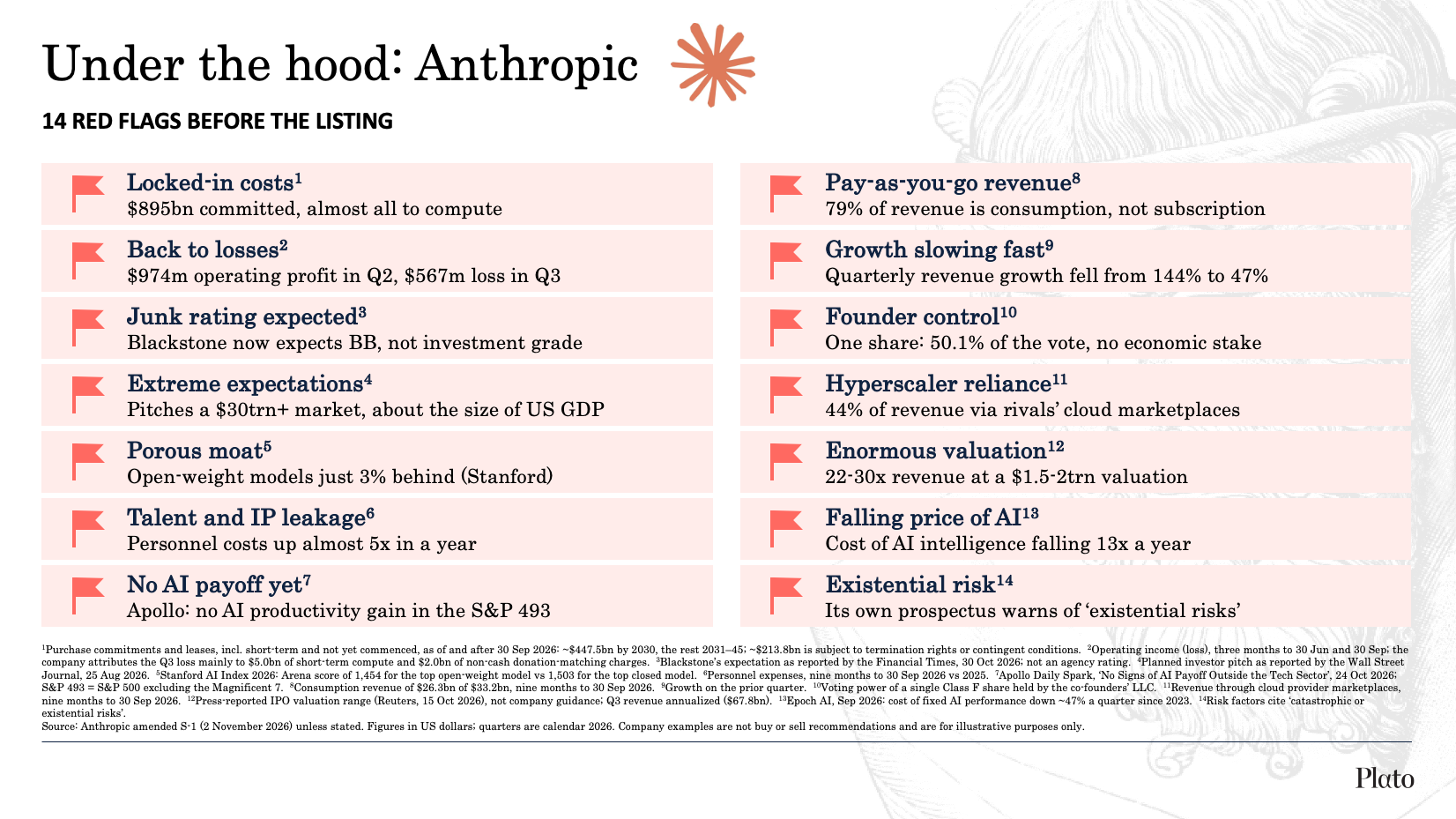
All up, the team found 14 Red Flags in total. The full list can be seen here:
AI: ‘Asymmetry Inverted’
I don’t know whether Anthropic will prove to be a wonderful investment or an expensive lesson. Early reports are that the book is already covered so we would expect it to trade well in the very short-term. But after 25 years in markets, I’ve learned that avoiding disasters can be just as important as finding winners.
For us, the job of a fund manager is to protect investors from outsized downside risk – as I’ve said before, our risk systems are designed to act as the proverbial flak jacket – to identify and manage potential outsized downside risks across our portfolios.
At the risk of sounding cliche, Warren Buffett put it simply: Rule number one is don’t lose money. Rule number two is don’t forget rule number one.
If you would like to learn more about investing in our global investment fund, The Plato Global Alpha Fund, click here to visit the Fund page on this website where you can also access the PDS and TMD, or search for the ASX ticker ‘PGA1′ wherever you invest.
Disclaimer:
This communication is prepared by Plato Investment Management Limited AFSL 504616 ABN 77 120 730 136 (‘Plato’).
Whilst Plato believes the information contained in this communication is based on reliable information, no warranty is given as to its accuracy and persons relying on this information do so at their own risk. Subject to any liability which cannot be excluded under the relevant laws, Plato disclaim all liability to any person relying on the information contained in this communication in respect of any loss or damage (including consequential loss or damage), however caused, which may be suffered or arise directly or indirectly in respect of such information. Companies mentioned are for illustrative purposes only and are not a recommendation to buy, hold or sell any particular security.
Pinnacle Fund Services Limited ABN 29 082 494 362 AFSL 238371 is the product issuer of the Plato Australian Shares Income Fund (ARSN 152 590 157) and the Plato Global Shares Income Fund – Active ETF (ASX:PGI2) (ARSN 608 130 838), managed by Plato. Any potential investor should consider the relevant Product Disclosure Statement available at https://plato.com.au/retail-funds/ in deciding whether to acquire, or continue to hold units in a fund. The issuer is not licensed to provide financial product advice. Please consult your financial adviser before making a decision. Past performance is not a reliable indicator of future performance.
The content in this communication is for general information only. Any opinions or forecasts reflect the judgment and assumptions of Plato on the basis of information at the date of publication and may later change without notice. Any projections are estimates only and may not be realised in the future. The information is not intended as a securities recommendation or statement of opinion intended to influence a person or persons in making a decision in relation to investment. Unauthorised use, copying, distribution, replication, posting, transmitting, publication, display, or reproduction in whole or in part of the information contained in this communication is prohibited without obtaining prior written permission from Plato.
SUBSCRIBE TO OUR NEWSLETTER
Subscribe to keep up to date with the latest fund
information and insights.
“A good decision is based on knowledge and not on numbers.”
Plato (427-347 BC)